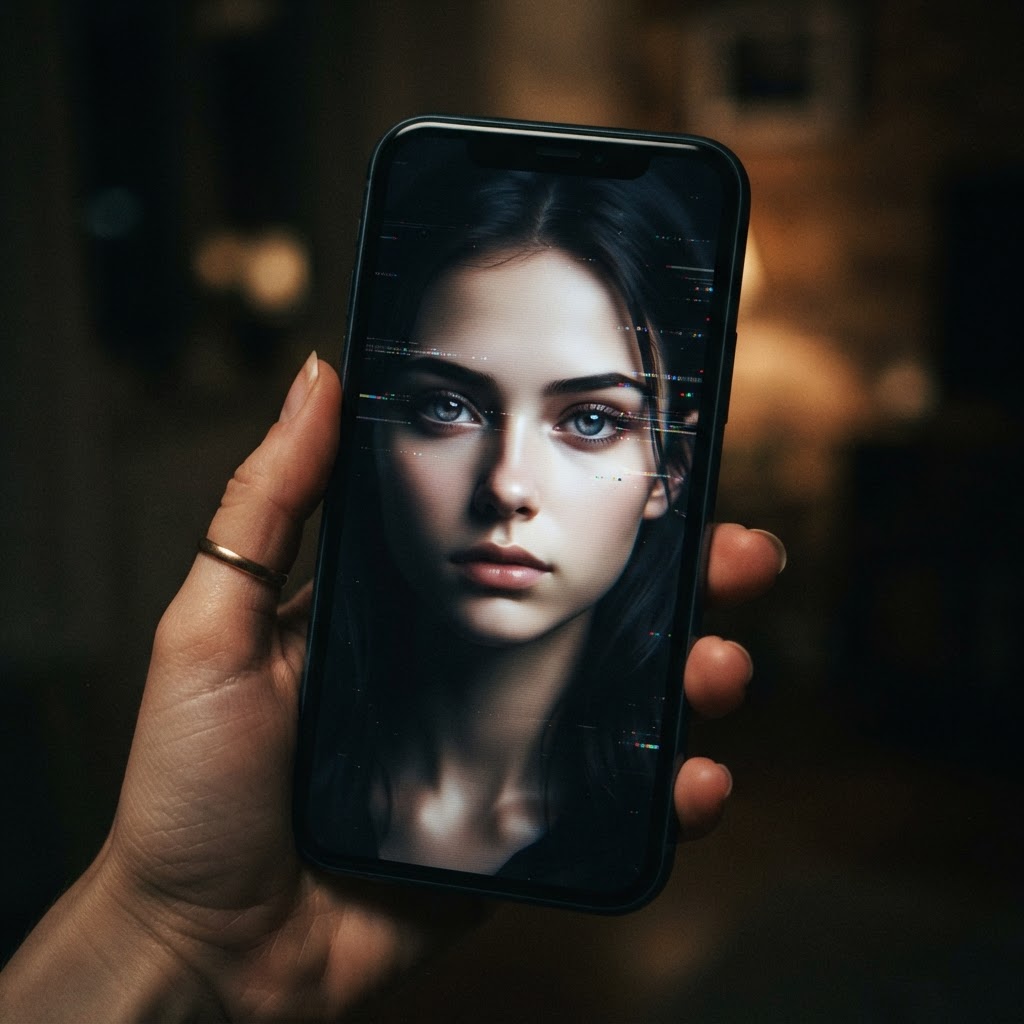
AI-Generated Photos on Dating Apps: How to Spot Them
The new face of fake
For years, the easiest way to catch a fake dating profile was a reverse image search: stolen photos showed up elsewhere on the internet. That trick still works — but it's no longer enough.
Today, scammers can generate faces that never existed. A few seconds with an AI image tool, and they have a unique, realistic-looking person who appears nowhere else online. Reverse search finds nothing, because there's nothing to find.
Here's how to tell when a dating photo might be AI-generated, and what to do about it.
Why scammers use AI faces
Stolen photos are risky for scammers. The real owner might report the fake profile. Reverse image search might expose it. The victim might recognize a public figure.
AI-generated faces solve all of that. They're unique, so reverse search comes up empty. They're not a real person, so no one reports them missing. And with a few prompts, a scammer can generate a whole gallery of a consistent "person" — different angles, different outfits, same face.
It's the perfect catfishing tool, and it's getting better fast.
The tells of an AI-generated face
Current AI image generators are good but not perfect. They struggle with the same things, over and over. Look closely at:
The eyes and glasses
- Asymmetrical glasses — one lens different from the other, or frames that don't sit level.
- Mismatched earrings — a stud on one ear, nothing on the other.
- Irregular pupils — slightly different sizes or shapes.
The teeth and mouth
- Blurred or fused teeth — instead of individual teeth, a smooth white mass.
- Too many teeth — a smile that shows an impossible number of teeth.
- A mouth that doesn't quite align with the rest of the face.
The hands and fingers
When hands are visible, AI often produces:
- Too many fingers, or too few.
- Fingers that merge or bend wrong.
- Hands that don't grip objects realistically.
The background and edges
- Warped backgrounds — straight lines that bend, walls that melt into furniture.
- Floating objects — a glass with no table under it, hair that merges into a collar.
- Inconsistent lighting — shadows that fall in different directions across the photo.
The skin
- Too perfect — poreless, flawless, almost plastic. Real skin has texture, especially in casual photos.
- Blur where there should be detail — AI often smooths areas it can't render precisely.
The whole-profile tells
Beyond individual photos, look at the profile as a whole:
- Every photo is a perfect solo portrait. No group shots, no candid moments, no one tagged. Real people are photographed by other people.
- The "person" looks slightly different in each photo. Same general face, but the bone structure shifts, the ears change shape, the smile is different. AI struggles to keep a face perfectly consistent across generations.
- No video, ever. An AI face can't get on a video call. If they refuse video, that's the tell.
- The life doesn't match the photos. They claim a specific job and city, but the photos could be anywhere. AI images have generic, hard-to-place backgrounds.
What to do
Zoom in
Don't just glance at the profile. Save the photos and zoom in on the details — the glasses, the teeth, the hands, the edges of the hair. AI artifacts hide in the parts you don't usually look at.
Still run a reverse search
AI faces won't appear elsewhere — but the scammer might have mixed in a real stolen photo, or used a known AI face that's been flagged. A clean reverse search isn't proof of real, but a dirty one is proof of fake.
Insist on video
This remains the single best test. An AI-generated face cannot appear on a live video call. If they won't video call, treat the profile as unverified — at minimum.
Use AI-image detection
There are now tools (and verification services) that specifically analyze whether an image is AI-generated, looking for the statistical fingerprints of generative models. This is the next layer beyond reverse search, and increasingly necessary.
The honest reality
You can't always tell. The technology is improving, and some AI faces now pass casual inspection. The goal isn't to become a forensic expert — it's to know when to be suspicious enough to verify further.
If a profile has several AI tells, refuses video, and pushes for emotional or financial commitment, the safe assumption is that the person isn't real — regardless of how attractive the photos are.
A verification report can run both reverse-image matching and AI-generation analysis on a profile's photos, and combine that with identity and public-record checks to give you a clearer answer than your eyes alone.
Worried a profile might be AI-generated? VerifyMyDate analyzes photos for reuse and AI generation as part of a private report.
Want us to verify your date?
VerifyMyDate compiles public records, identity checks and photo intelligence into one private, evidence-based report. The person you search is never notified.
Check Someone Now — $19.99